K-Rail Protection
When it comes to traffic control solutions, Roadway Construction Services (RCS) is no stranger to challenges. K-rail barricades are your perfect option for long-term jobs or even permanent barricades. These are often used to safely manage traffic lanes, though they are the best choice in many instances in which construction will be taking place over a long period of time.
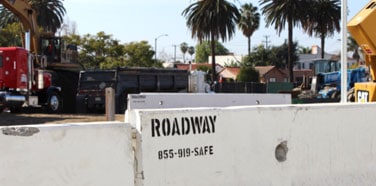
When Roadway Construction Service tackles a long-term traffic control project, we often deploy k rail to protect the affected area. That certainly was the case for a recent Los Angeles project. For this job, located on La Brea Blvd., k rail was utilized for the Holland construction site. This work zone isn’t exactly small. It’s a sprawling, 2-story parking structure and surrounding area located on one of SoCal’s busiest streets. We’re talking a steady stream of night and day traffic.
Available Now: (562) 903-0011
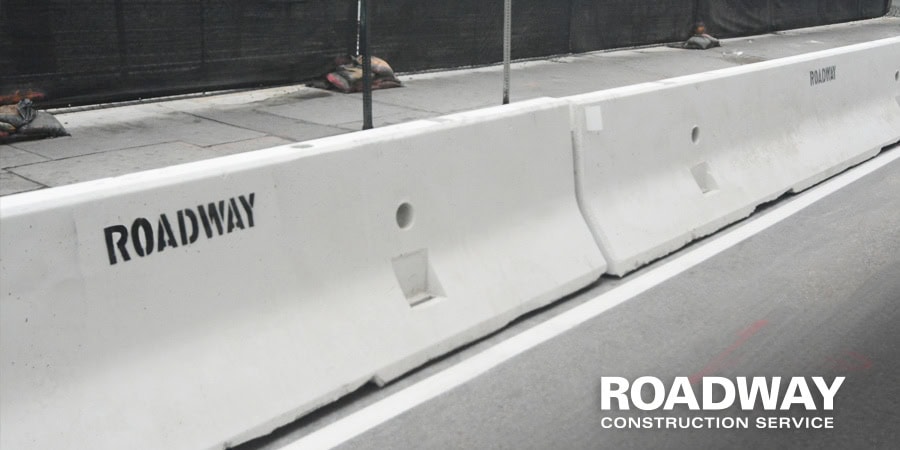
For this project, Roadway Construction Service opted for concrete k-rail instead of the water-filled plastic alternative. With good reason. The material is considerably heavier than plastic, requiring a more time-consuming setup than the lighter variety. Clearly, it’s the right choice for long-term assignments like this. Plus, being stronger than plastic, concrete maximizes protection – exactly what this major La Brea project demanded. On this job, we utilized 8000 lb. segments of solid concrete to create an impervious wall.
Separating an Active Work Area from the Public
One of our primary project goals was to separate the public from the active work area. For vehicles, separation is achieved by k-rail’s wall-like structure and its sloped surface, which redirects encroaching vehicles to appropriate lanes. As with vehicles, the k rail wall separates pedestrians from work areas. It also separates foot travelers from flying debris such as gravel, which may emanate from a job site. Basically, it functions as a shield. For property, the barricades are designed to keep machinery and equipment within specific boundaries, thereby safely separating them from nearby property.
Planning K-Rail Placement Around Excavation
To ensure effective k rail deployment, Roadway Construction Service considered many factors. Among these were available space, equipment access, project boundaries, and coordination with the construction team. It was imperative to position the barricade at the proper ‘setback’ distance from the edge of the excavation. But the proper distance is variable. According to OSHA regulations, unanchored K-rail must be set back at least two feet from the edge. Anchoring, on the other hand, is required for a barricade closer than two feet.
Coordinating K-Rail Delivery, Placement, and Removal
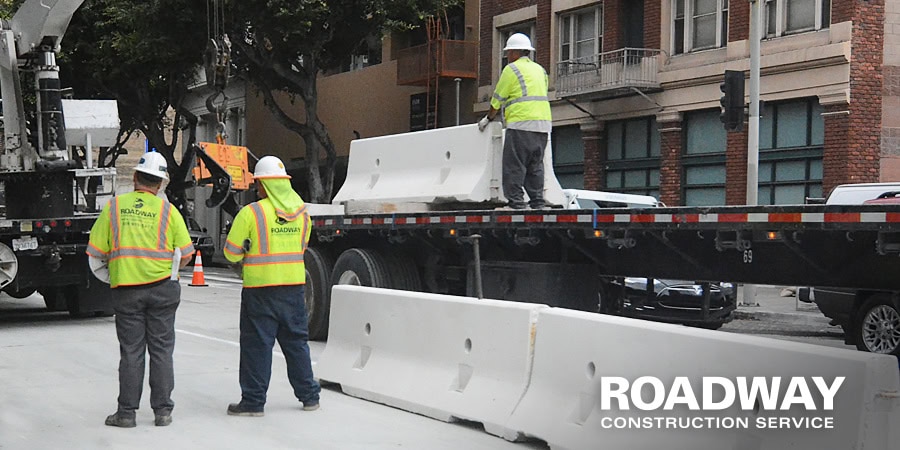
Roadway Construction Service utilized its experience and knowledge to the fullest, coordinating k rail delivery, placement, and removal with unmatched precision. The process launched with important preliminary steps. These included acquisition of encroachment permits and approvals from the Department of Transportation, and the development of a comprehensive traffic control plan.
Developed by our team of master strategists, the plan incorporated an array of considerations such as traffic routes used during K rail installation. A supplemental blueprint indicated the position of each barricade segment and confirmed the barricade’s non-interference with infrastructural elements such as utilities and drainage systems.
As you can imagine, a project of this magnitude presented a diversity of challenging delivery logistics. To ensure a safe, efficient delivery process, our number crunchers calculated the freight capacity of each delivery truck, which would be transporting 8,000 lb. segments to the work site. We also coordinated the arrival of offloading equipment, such as cranes, a process optimally synced to delivery arrivals. And, of course, this flurry of activity was timed perfectly to accommodate client schedules. As a rule, we schedule deliveries to avoid peak hours and thereby minimize traffic disruptions.
K-Rail Rental for Short-Term and Long-Term Projects
For virtually all k rail deployments, rental needs change as duration and project phases change. Roadway Construction Service handles this dynamic situation with unsurpassed efficiency, providing flexibility and adaptability through all stages of the process.
The first stage, for example, requires a series of preliminary work zone preparations. K rail is utilized to define work zone boundaries and delineate routes for equipment transport.
During the excavation stage, we adapt to the situation by deploying k rail close to traffic routes to optimize conditions for activities such as trench creation and utility movement.
Paving and construction demands another change to k rail configuration. During this phase, we engage in continued k rail repositioning to accommodate activities such as lane shifts and concrete pouring. As each phase of construction is completed and approved, we remove the k rail where appropriate to accommodate diminishing needs.
Finally, during the post construction phase, we remove remaining k rail barriers. For certain long-term projects, however, some barricade sections remain as needed (sometimes for months) until the project receives final approval.
High performance, however, doesn’t mean high price. Roadway Construction Services offers clients competitive pricing for both short term rentals and long term leasing of all traffic control resources. Their expert services include transportation to and from projects, placement, and product removal – all superbly protected through the establishment of a safe, secure work environment.
Clearly, Roadway Construction Service offers ultimate k rail protection for Los Angeles and throughout Southern California. And we’re ready to discuss your Los Angeles K rail requirements. Simply contact Roadway Construction Services at (562) 903-0011 to learn why we set the standard in the traffic control service, planning, and permitting industry.